

How Much Does It Cost to Start an Online Casino in 2026?

Table of Contents
- Introduction
- Online Casino Industry Growth
- Why Cost Estimation Matters
- Types of Online Casino Business Models
- Online Casino Startup Cost at a Glance
- Key Cost Components
- Estimated Total Startup Cost
- Tips to Reduce Online Casino Startup Costs Without Sacrificing Quality
- ROI and Break-Even Timeline
- Final Thoughts
- FAQs
Introduction
Mobile accessibility, faster internet connections, digital payments, live casino experiences and continued regulatory development are helping expand the market. However, market growth does not guarantee profitability for every operator.
In this guide, we’ll break down the major online casino startup costs, including licensing, software, game providers, payment systems, UI/UX, marketing, compliance, security, staffing and ongoing maintenance.
DID YOU KNOW?
The global online casino market was valued at USD 19.1 billion in 2024 and is estimated to reach USD 23.9 billion in 2026. Grand View Research projects the market to reach USD 38.0 billion by 2030, representing a 12.2% CAGR from 2025 to 2030.
Online Casino Industry Growth
Operators still need to manage customer acquisition costs, licensing requirements, payment processing, compliance, game-provider fees and ongoing technology expenses. This makes accurate cost planning an essential part of building a sustainable online casino business.
Why Cost Estimation Matters
Running an online casino requires spending on multiple aspects such as
- Licensing
- Software
- Payment Systems
- Employing Staff
- Customer Support
- Ongoing Maintenance
Types of Online Casino Business Models
When starting an online casino or a real-money online casino, one of the first choices is how to set up your platform. You can choose a white-label casino, a turnkey solution, or build it from scratch. Each option differs in cost, control and complexity.

1. White-Label Casinos
Definition: A white-label casino uses an existing platform supplied by a third-party provider. Depending on the agreement, the provider may supply platform infrastructure, game integrations, licensing arrangements, payment connectivity, compliance support and other operational services. The operator generally focuses on branding, marketing, player acquisition and day-to-day business management.
Pros:
- Quick to launch
- Lower starting cost
- Support with rules and tech
- Less work to manage
- Limited control and customization
- Potential revenue-sharing or recurring platform fees
- Dependence on the provider’s system and license Less flexibility than turnkey or custom platforms
2. Turnkey Casino Solutions
Definition: A turnkey casino solution provides a prebuilt platform that can be customized for a specific operator’s brand, game portfolio, payment systems and operational requirements. Compared with white-label models, turnkey solutions generally provide greater control over the platform and may allow the operator to manage its own licensing and operational relationships, depending on the agreement.
Pros:
- Launching is faster than starting from scratch.
- More control over branding and the customer experience
- Access to a lot of games and tools
- Control of player data and operations
- More expensive upfront than white-label solutions
- Involvement in licensing, compliance, operations
- Licensing must be obtained independently
- Ongoing technical management needed
3. Building from Scratch (Custom Solutions)
Definition: It means building a unique online casino platform from scratch, including the software, licensing, payment systems, security measures and game integrations. Custom development creates ongoing responsibilities after launch, including software maintenance, security updates, infrastructure management, quality assurance, compliance changes and engineering resources.
Pros:
- You have complete control over the design, features and functionality.
- Distinctive branding that sets you apart from the competition.
- Complete ownership of platform and player data
- Scalability and long-term flexibility
- The highest development and operational costs
- Longer time to market
- Requires a large, experienced team
- Complex legal and compliance processes
Online Casino Startup Cost at a Glance
Business Model | Typical Setup Range* | Best Suited For |
White-label | $15,000–$150,000+ | Fast market entry |
Turnkey | $80,000–$200,000+ | Operators seeking more control |
Custom | $250,000–$700,000+ | Funded operators seeking ownership |
Key Cost Components
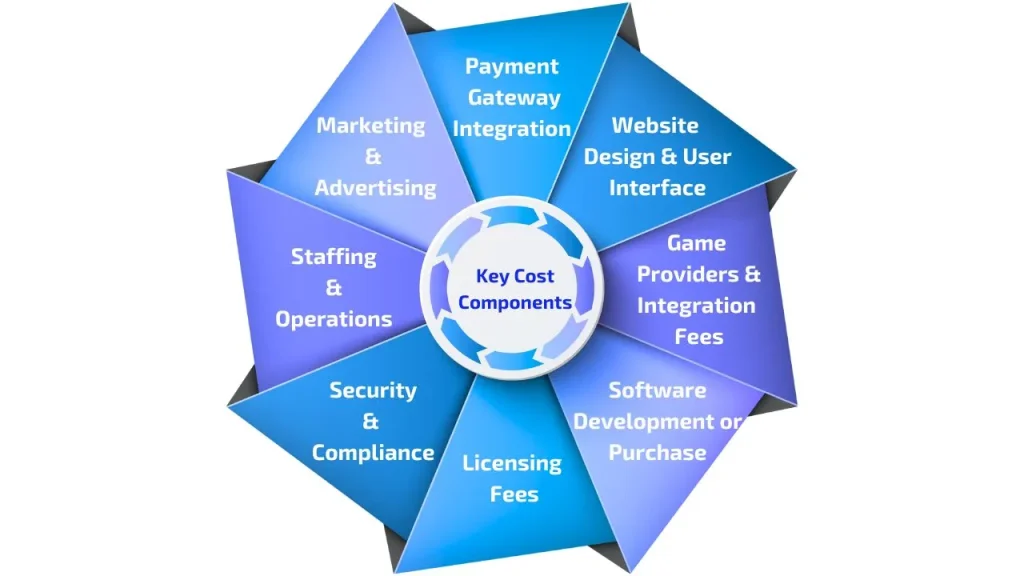
There are several important costs associated with starting an online casino that can significantly affect your budget. To make sound financial plans and achieve long-term success, you need to understand the full extent of these charges. Here is a list of the primary things that affect the cost:
-
Licensing Fees
Jurisdictions:
Malta, Curacao, the Isle of Man, Gibraltar, and Kahnawake are all popular places to get a licence. Each has its own rules and fees that must be followed.
Estimated License Costs:
- The online casino license costs anywhere from $10,000 to more than $100,000, depending on the sort of license and where you live.
- Curacao tends to be the most affordable, while Malta and the Isle of Man are more reputable but expensive.
Ongoing Renewal & Compliance Costs:
- Annual renewal fees
- Regular audits and compliance updates
- Legal and consultation services
-
Software Development or Purchase
Custom Software Development:
- Fully tailored platforms may cost $50,000 to $500,000+, depending on features, complexity and development team.
Pre-Built Software/Platform Costs:
- White-label and turnkey platform costs vary significantly by provider and scope. Current industry estimates place white-label setups around $15,000–$150,000+, while turnkey implementations can reach $80,000–$200,000+ depending on customization and integrations.
Integration with Third-Party Software:
- The integration cost depends on how many connectors you need and their categories such as CRM, payment gateways or analytics tools.
-
Game Providers & Integration Fees
Top Providers:
- Popular names include Tecpinion, NetEnt, Microgaming, Evolution Gaming, Play’n GO, and Pragmatic Play.
Fee Models:
- Per-game licensing fees or revenue-sharing models (usually 8%–17% of GGR).
- Some providers may charge setup fees per integration.
API Integration Costs:
- Costs can range from $5,000 to $50,000 or more, depending on the provider and the number of games included.
-
Website Design & User Interface
Importance of UI/UX in iGaming:
A professional and user-friendly design encourages players to return and increases conversions, which is crucial in the highly competitive iGaming industry.
Cost Estimate:
- Basic custom design starts at $5,000
- High-end, fully optimized designs can exceed $25,000
-
Payment Gateway Integration
Secure Payment Processing:
- It’s important to provide flexibility with multiple payment options, such as credit cards, e-wallets, and cryptocurrencies, for deposits and withdrawals.
Fees:
- Setup costs vary by provider
- Transaction fees typically range from 1% to 3.5%
Fiat vs Crypto Support:
- Supporting crypto may involve additional integration and security considerations, but it also attracts a broader user base.
-
Marketing & Advertising
Channels:
- Affiliate programs
- PPC (Pay-Per-Click) campaigns
- SEO
- Influencer partnerships and content marketing
Estimated Monthly Cost:
- Budget can range from $10,000 to over $50,000, depending on your marketing strategy and growth goals.
-
Staffing & Operations
Roles Required:
- Customer support
- KYC/AML compliance teams
- Technical support and maintenance
- Marketing and CRM specialists
Cost Comparison:
- In-house teams provide greater control but come with higher costs.
- Outsourcing is often more cost-effective but depends on having reliable partners.
-
Security & Compliance
- SSL certificates for secure connections
- Anti-fraud and anti-cheating systems
- Responsible gaming tools (limits, self-exclusion, etc.)
- Security costs vary according to platform architecture, traffic volume, risk exposure, regulatory requirements, third-party security services and testing requirements.

Estimated Total Startup Cost Range
The Total investment depends on the platform model, target jurisdiction, the number of integrations, game portfolio, payment infrastructure, compliance requirements and marketing strategies. The following ranges are helpful for starting a discussion about a person’s position, but should not be used as any kind of definitive quotations:
-
Small-Scale (White-Label Solution): $25,000 – $60,000
Includes:
- Initial setup fees
- Licensing through the provider
- Basic UI customization
- Access to pre-integrated games
- Limited marketing budget
-
Mid-Range (Turnkey Solution): $10,000 – $50,000
Includes:
- Platform licensing and integration
- Game provider agreements
- Website/UI customization
- Payment gateway setup
- Initial marketing campaigns
- Partial in-house staffing
-
High-End (Custom-Built Platform): $80,000 – $3,00,000+
Includes:
- Full custom software development
- Game engine or third-party game integrations
- Advanced UI/UX design
- Independent licensing fees
- Compliance systems
- Full marketing campaigns
- In-house teams for support, tech, legal, and compliance
Ideal for:
Funded businesses that want to build a unique, scalable brand with full control over operations and the ability to grow over time. Analysing your budget, goals, and technical resources will help you choose the best method and develop a sound investment plan.Would You Like To Explore More About Online Casino?
Tips to Reduce Costs Without Sacrificing Quality
1. Choosing the Right Jurisdiction
Selecting a cost-effective licensing jurisdiction can significantly reduce initial and ongoing regulatory expenses.
- Curacao and Kahnawake are more affordable and faster to obtain than high-tier options such as Malta or the Isle of Man.
- Top-tier licences are more credible, but starting with lower costs can help you get started faster.
2. Starting with Fewer Games
Rather than integrating many game providers at launch, start with a smaller selection of popular titles.
- Expand the game library based on player demand, engagement and revenue performance.
- Gradually expand your game library based on user demand and revenue performance.
3. Outsourcing Specific Roles
Hiring a full in-house team can be expensive, especially in the early stages.
- Outsource tasks that aren’t part of your main business such as customer service, KYC/AML verification, graphic design or technical maintenance.
- Use experienced service providers or freelancers to keep staffing costs low without sacrificing expertise.
4. Choose a Scalable Casino Platform
Choose a ready-to-launch platform that can reduce development time and initial technical costs.
- Compare providers based on customization, game integrations, payment support, security, compliance tools and scalability.
- Check the provider’s setup fees, recurring costs, revenue-sharing terms and third-party charges before signing.
- Choose a platform that can support additional games, payment methods, markets and features as your business grows.
- A scalable solution from providers such as Tecpinion can help operators launch efficiently while keeping future expansion in mind.
ROI Expectations & Break-even Timeline
Time to Profitability:
The average break-even timeline for an online casino typically ranges from 12 to 24 months, depending on the scale and strategy.
- White-label casinos may reach break-even sooner (within 6–12 months) due to lower startup costs.
- Turnkey and custom-built platforms may take longer (18–24 months or more), especially if you put a large down payment up front.
Factors Affecting ROI:
-
Player Acquisition Cost (CPA):
- Using PPC, affiliates or influencer marketing to acquire new users could be costly.
- Efficient targeting and competitive bonuses can lower CPA.
-
Player Retention:
- Retaining players through loyalty programs, regular promotions and excellent support increases lifetime value (LTV).
- A loyal player base improves ROI significantly over time.
-
Marketing Efficiency:
- Maximising ROI depends on how well you spend your marketing money such as by improving SEO, affiliate deals and social media.
- High return on ad spend (ROAS) shortens the path to profitability.
-
Game Mix & RTP (Return to Player):
- Offering a balanced portfolio of games with varying RTPs can influence profit margins.
- Popular games with high engagement help boost deposits and reduce churn.
- Popular games drive high engagement, helping boost deposits and reduce churn.
-
Payment Processing & Fraud Management:
- Lower transaction fees and good fraud protection keep your margins safe.
- Smooth withdrawals and deposits improve user satisfaction and retention.
-
Regulatory Compliance & Operational Efficiency:
- Minimizing fines, delays and legal costs through proactive compliance ensures smoother operations and better cash flow.
-
How to Calculate the Casino Break-Even Point
- Break-even point = Fixed Costs ÷ Contribution Margin
- Operators should also model key performance indicators such as CPA, player LTV, conversion rate, retention, churn, GGR and NGR to estimate how quickly the initial investment can be recovered.
Final Thoughts
White-label solutions can provide a faster and lower-cost entry point, turnkey platforms offer a balance between customization and launch speed and custom development provides the greatest level of control for operators with larger budgets and long-term technology goals.
Before choosing a platform, compare the total cost of ownership, not just the initial setup price. Request a complete breakdown of one-time fees, recurring charges, revenue sharing, integrations, licensing, support and third-party services. For businesses looking for a customizable technology partner, Tecpinion can help evaluate platform requirements, integrations, features and scalability as part of an online casino launch strategy.
FAQs
- How much does it cost to start an online casino?
It usually costs between $15,000 and $100,000+, depending on the software, license, payments, and marketing.
- What affects the total cost?
Main factors are licensing, software, games, payment systems, marketing, and daily operations.
- How much does a casino license cost?
License costs vary by jurisdiction, ranging from $10,000 to $50,000 or more.
- Can I start a casino without a license?
No. Most of the time, starting an online casino without a license is termed illegal and a violation of the law. Apart from legal challenges, it can also lead to trust issues among your players and stakeholders.
- How much does casino software cost?
Casino software usually costs $10,000 to $50,000, based on features, customization, and scalability.
- Are there costs after launch?
Yes. You will need to keep paying for hosting, support, game updates, and marketing.
- How much should I budget for marketing?
Marketing can take up 20–40% of your total budget, especially in the early growth phase.
- Is there a cheaper way to start an online casino?
Yes. Using white-label casino solutions can significantly reduce costs and speed up launch compared to building from scratch.
- What is a turnkey casino?
A turnkey solution is prebuilt software with basic technology, but you can customise elements such as the design, game selection, content and marketing to fit your brand. You usually run the platform with your licence.
Want to know more
about Online Casino
read out the Related Blogs
Recent Post
-
API-First iGaming Software: Everything Operators Need to Know in 2026
-
The Best Online Casino Bonuses That Attract More Players
-
iGaming Platform Migration: How to Switch Software Providers Without Losing Players or Data
-
Predictive Analytics in Social Casinos: How Platforms Know What Players Want Next
-
Top 10 White Label Online Casino Software Providers for Startups