

Tecpinion achieves GLI-19 certification, meeting global iGaming standards & enabling operators to scale across markets. Learn more
tecpinion logo 1

Today’s evolving iGaming landscape is shaped by changing regulatory requirements, rising player expectations, and increasing competition across global markets. 

API-First iGaming Software: Everything Operators Need to Know in 2026

API-First iGaming Software

Table of Contents

Introduction

Today’s evolving iGaming landscape is shaped by changing regulatory requirements, rising player expectations, and increasing competition across global markets. 

So, to drive growth for operators amid these challenges, a robust online casino platform architecture is essential and must not compromise on speed, efficiency, scalability, or performance.  

As the casino business creates new opportunities, an outdated iGaming system makes the process complex and limits the scope for growth. In this modern era of gaming, standardised features and tools with a traditional operational structure no longer hold significance. 

These circumstances have prompted casino operators to look towards API-first iGaming platforms, as they offer extensive capabilities and immense potential needed to succeed in this highly competitive arena.  Today, in this blog, we are going to uncover the role of API-first iGaming platforms and how they help operators achieve desired results 

DID YOU KNOW?

The global market size of API management previously stood at USD 6.89 billion in 2025 and is expected to reach USD 37.43 billion by 2034, with a growth estimate of 21.70% CAGR – Fortune Business Insights 

What Is API-First iGaming Software?
API-first iGaming software solution is a modern approach that involves designing Application Programming Interfaces (APIs) before developing the application software or backend functionality. 

What does modular architecture mean in iGaming?

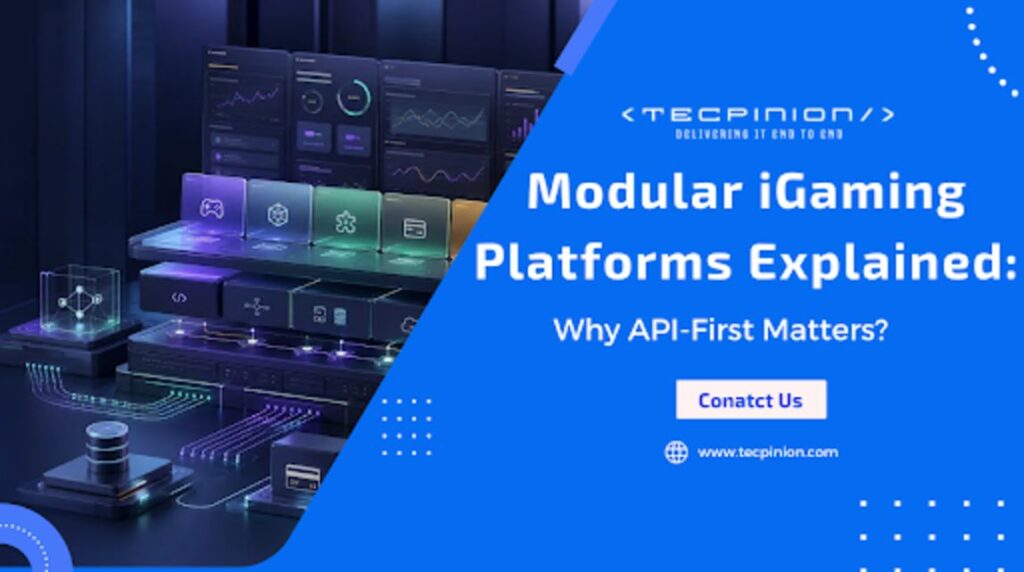
Rather than operating in a closed system interconnected with all components, the modular iGaming platform is built with different APIs that enable independent services, applications, and third-party providers to communicate seamlessly. 

This modular structure allows operators to add casino games, sportsbooks, payment gateways, KYC and AML solutions, customer relationship management (CRM) tools, loyalty programs, and more. All features and services are built with clearly defined interfaces that operate independently but remain connected through APIs, creating a flexible and scalable ecosystem.

Here are some viable reasons for operators to look away from traditional platforms and choose modular iGaming platforms.

  • Faster market entry
  • Reduced development and maintenance costs
  • Improved flexibility of third-party providers
  • Enhanced player experience through seamless integrations
  • Greater scalability to support long-term growth
This all makes it an ideal choice for operators seeking faster deployment, greater customization, and adaptability to market trends and regulatory changes.
Key Components of an API-First iGaming Platform
The modular iGaming platform has always been at the center stage, especially in this modern gambling space. The structure allows operators the flexibility to add new features, change providers, and scale growth. 

From game aggregation, payment processing, player management, and regulatory compliance, all components are critical. All these components have to work cohesively together for operators to deliver a secure, engaging, and efficient gaming experience.
  • Game Aggregation APIs

It enables operators to integrate casino content from multiple game providers through a unified interface. With the help of game aggregation platforms, operators can access a huge number of slot games, table games, live dealer titles, instant games, and more through a single API. The APIs help operators keep the game library fresh and competitive without much technical complexity 

  • Payment Gateway APIs

They coherently manage banks, digital wallets, payment processors, and cryptocurrency, ensuring players can safely deposit and withdraw funds.  The reliable payment integrations improve transaction speed, reduce payment failures, and enhance the overall player experience.

  • Player Account Management (PAM) APIs

Player account management is the backbone of iGaming platform software, handling different operational aspects.  This includes player accounts, verification processes, wallet balances, gaming history, responsible gaming policies, and account security.  A good PAM system enables you to manage your users with ease and supports security and compliance.

  • KYC, AML, and Compliance APIs

iGaming operators must comply with security standards. These APIs are responsible for identity verification, fraud prevention, and responsible gaming practices. Aligning with automation, they help operators meet legal requirements across jurisdictions.  It also plays an active part in reducing manual processes and improving security and regulatory compliance.

  • CRM and Bonus Management APIs

Customer Relationship Management (CRM) APIs enable iGaming businesses to build strong player relationships through personalised marketing campaigns, loyalty programs, and promotional offers. These APIs boost retention rates by providing targeted and relevant player experiences. 

  • Business Intelligence and Analytics APIs

The API enables operators to gain actionable insights by sourcing and analyzing data on player behavior, financial performance, and operational efficiency. The real-time reporting features enable operators to make informed business decisions and optimize platform performance.

  • Sportsbook and Odds APIs

These API’s are specifically for sportsbook operators to offer real-time access to sporting events, betting markets, odds, and settlement data. Sportsbook APIs help operators expand beyond casino gaming and deliver a comprehensive betting experience.

  • Security and Authentication APIs

Security APi’s are critical as they protect player data and platform infrastructure. Their specialty is controlling access and monitoring suspicious activity. The integrations help operators protect sensitive information and maintain player trust. 


Therefore, the API-first architecture for online casinos involves the smooth integration of game aggregation, payment processing, player account management, compliance, CRM, analytics, sportsbook, and security APIs. 

All these components are important to build a future-ready ecosystem that is flexible and scalable enough to launch new features quickly, integrate best-in-class third-party services, and adapt to changing market demands. Next, let’s look in detail at the benefits of modular casino platforms for operators.
Benefits of API-First Software for Operators
API-first apps are one of the big tech trends in iGaming today. The integrated, modular architecture allows casino platform operators to instantly offer new products, bring new services online, and scale their operations.

This approach allows businesses to integrate with the best services for games, payments, compliance, CRM, analytics, and more. Thus, it improves operational efficiency and creates growth opportunities.
01
↗

Faster Integrations and Time-to-Market

The biggest advantage of API-first software is its ability to o integrate new services quickly and efficiently. Operators can seamlessly connect with game providers, payment gateways, compliance features, marketing tools, and more without redevelopment.


02
âš™

Greater Flexibility and Customization

Operators can choose their technologies and service providers that align with business requirements. Rather than being confined to a single vendor ecosystem, it gives operators the flexibility to build a customised technology stack. Moreover, there lies scope for a unique gaming experience and a way to differentiate themselves from competitors.

03
↗

Improved Scalability and Business Growth

As player numbers rise and operations expand into new markets, platforms must be capable of handling larger transactional volumes and additional services. The scalable iGaming platform architecture ensures long-term operational stability and business continuity.

05
↓

Lower Development and Maintenance Costs

Conventional platforms can be costly and time-consuming to maintain and update. By separating services into modular components, API integration reduces operational complexity and allows each module to be updated independently. As a result, operators can optimize resources without compromising platform quality.

06
✓

Easier Compliance and Security Management

Regulatory compliance is a critical aspect for online casino or sportsbook operators. It allows them to integrate with specialised third-party solutions for KYC, AML, responsible gaming, and geo-location verification. They help operators maintain compliance and reduce operational risk.

07
✦

Access to Innovation and Emerging Technologies

The iGaming industry is changing fast, with new payment methods, AI tools, analytics platforms, and player engagement technologies. Operators can use these innovations through an API-first approach, without having to redevelop their core platform.

✦

This indicates the platform continues to evolve as the industry changes. Overall, this APi architecture creates a powerful foundation for businesses to build flexible, scalable, and innovation-driven iGaming platforms.

Every development in the iGaming industry presents a challenge; likewise, there are certain barriers in advancing with API-driven platforms

Challenges and Best Practices for API Integration
API architecture provides many benefits to iGaming operators, but proper implementation requires extensive planning and ongoing management.

Modern iGaming platforms have become integrated with multiple APIs for games, payment gateways, sportsbook services, player account management, CRM systems, KYC and AML verification, fraud prevention, analytics, and responsible gaming needs.

It makes the platform more flexible and scalable but also brings in technical and operational challenges. Operators can overcome these challenges, reduce operational risk, and build a reliable API ecosystem to support long-term business growth by following industry best practices.

  • Managing Multiple Third-Party Integrations

A major concern for API-first platforms is managing various third-party providers.  As each provider may use different API standards, authentication methods, documentation, and update schedules,  integration becomes more complex. 

To navigate these issues, operators can adopt a centralised strategy that simplifies platform management and reduces technical overhead.

  • Maintaining Security and Data Protection

Sensitive information such as player data, payment details, and identity verification is transferred between APIs. So without proper security controls, APi become vulnerable to cyberattacks and data breaches.  Robust API security protects both player information and business operations.

  •  Ensuring High Performance and Scalability

With increasing visitor volume, APIs must handle thousands of requests simultaneously without affecting platform performance. Poorly optimized integrations can lead to latency, downtime, and a degraded player experience.  Operators must ensure a smooth gaming experience, even during high-traffic periods.

  • Handling API Versioning and Updates

Technology service providers continuously improve security, address issues, and add new functionality to their APIs. In the absence of proper control, these modifications will hinder platform operations Version management is a good way to minimize downtime and maintain business continuity.

  • Meeting Regulatory and Compliance Requirements

Gambling operators must comply with different regulations across jurisdictions. Adapting to changing legal requirements by integrating with compliance-related APIs can be challenging.  Therefore, with a proactive compliance strategy, operators can reduce legal risks and meet licensing requirements.

  • Continuous Monitoring, Testing, and Optimization

Integrating APIs is not a one-time task and is an ongoing process. Regular monitoring allows operators to identify and resolve issues quickly. It is required to ensure APIs remain reliable, efficient, and aligned with evolving business objectives.

Even as platforms become flexible and scalable through API-first architecture, effective implementations depend on management of security, performance, third-party services, compliance, version control, and ongoing monitoring. The best practices for a stable and future-ready iGaming platform include API gateways, secure authentication, cloud-native infrastructure, automated testing, and continuous performance optimization.
How to Choose the Right API-First Platform
The platform is the technological backbone for the gambling business. It is a deciding factor for game integrations, payment processing, regulatory compliance, player experience, and long-term scalability. 

While many providers in the market offer API-first solutions, not all platforms provide the same level of flexibility, performance, security, or support. So choosing the right API-first iGaming platform is one of the most important decisions for online casino and sportsbook operators.
01 ↗
Evaluate the Platform's API Architecture
02 ✦
Assess Integration Capabilities
03 ↗
Prioritize Scalability and Performance
04 â—Ž
Review Security and Compliance Features
05 ↓
Consider Customization and Flexibility
06 ✓
Evaluate Vendor Support and Long-Term Partnership
  • Evaluate the Platform’s API Architecture

The quality of an API-first platform is reflected through the strength of its underlying architecture. A strong API architecture reduces integration time and simplifies future platform enhancements.

When evaluating a platform, consider:
  • Comprehensive API documentation.
  • RESTful or modern API standards.
  • Secure authentication methoda
  • API versioning and backward compatibility.
  • Developer tools, SDKs, and sandbox frameworks.
 
  • Assess Integration Capabilities

A modern iGaming platform should seamlessly connect with the best services required to run an online casino or sportsbook. The flexible integration ecosystem makes it easier to expand your platform. Broad integration capabilities enable operators to choose their preferred technology partners. 

It should support :
  • Multiple casino game providers and aggregators.
  • Sportsbook and betting APIs.
  • Payment gateways and cryptocurrency solutions.
  • KYC, AML, and identity verification services.
  • CRM, bonus management, and loyalty platforms.
  • Business intelligence and reporting tools.
 
  • Prioritize Scalability and Performance

As the player base expands, the platform must be able to handle increasing traffic, high transaction volumes, and complex integrations without degrading performance. Cloud-native infrastructure and microservices-based architecture are strong indicators of scalability. A scalable platform is necessary for consistent performance as the business grows.

The touchpoints include:
  • Ability to support high player volumes.
  • Auto-scaling during peak traffic periods.
  • Fast API response times.
  • High platform uptime and reliability.
  • Efficient handling of real-time data and transactions.
 
  • Review Security and Compliance Features

Businesses require security and regulatory compliance to operate in a regulated market. These specialised tools and integrations enable player protections and maintain compliance—advanced security and compliance features that reduce operational risk and support licensing.

Evaluate whether the platform offers:
  • End-to-end data encryption.
  • Multi-factor authentication (MFA).
  • Secure API authentication and access controls.
  • Integrated KYC, AML, and fraud prevention tools.
  • Geofencing and jurisdiction management.
  • Audit logs and regulatory reporting capabilities.
 
  • Consider Customization and Flexibility

Each iGaming business has unique goals and branding requirements. An API-first platform should allow operators to customize both the player experience and backend functionality without major development efforts.  With a highly customizable platform, operators can differentiate themselves in a competitive market.

Look for features such as:
  • Flexible user interface customization.
  • Modular architecture for adding or replacing services.
  • Configurable bonus, loyalty, and CRM systems.
  • Support for multiple languages and currencies.
  • Easy integration of future technologies.
 
  • Evaluate Vendor Support and Long-Term Partnership

Technology is important, but the provider should also offer reliable software support, regular updates, and share a clear product roadmap to ensure long-term success.  A dependable technology partner is key to reducing operational challenges and accelerating business growth.

Before making a decision, operators should assess:
  • Availability of 24/7 technical support.
  • Quality of onboarding and implementation assistance.
  • Frequency of software and API updates.
  • Service Level Agreements (SLAs) and uptime guarantees.
  • Vendor reputation, industry experience, and client references.
Thus, selecting an appropriate API-first iGaming platform for business requires operators to evaluate API architecture, integration capabilities, scalability, security, customization, and vendor support.


A platform with well-documented APIs, cloud-native infrastructure, robust compliance tools, and a flexible modular design enables operators to launch faster, integrate best-in-class services, and adapt to evolving market demands.

Moving ahead, let’s analyse how operators can build a scalable and secure ecosystem. 
Building a Scalable and Secure API Ecosystem
A scalable, secure API ecosystem is the key to building a successful iGaming platform. This ecosystem enables operators to integrate with multiple game aggregators, payment gateways, compliance tools, CRM systems, and more.

Scalability enables the platforms to accommodate a large number of users, enter new markets, and introduce new services without disrupting existing functionality. 

Secure infrastructure protects sensitive player data, financial transactions, and platform resources from cyber threats while ensuring compliance with industry regulations.
Adopt a Microservices-Based Architecture The microservices architecture is an advanced API-first platform. All services are independent but communicate with each other via APIs. This architecture allows operators to scale their platforms more efficiently.
Leverage Cloud-Native Infrastructure It is important for modern iGaming platforms as it provides flexibility and computing resources. Cloud-native infrastructure enables operators to scale resources automatically based on player demand while maintaining high availability.
Secure APIs with Strong Authentication and Encryption APIs transmit sensitive player and financial data. So security must be embedded in every layer of the ecosystem. Weak authentication or unsecured data transfer might lead platforms to experience cyber-attacks and compliance risks. Robust security measures protect player information, ensuring only authorised systems can access platform resources.
Use API Gateways for Centralized Management Using an API gateway is a common entry point for all API traffic. It simplifies communication between services with security, monitoring, and traffic management capabilities. Centralized API management improves both operational efficiency and platform security.
Monitor Performance and Ensure High Availability Continuous monitoring in a scalable ecosystem is required to maintain trust and quickly identify performance issues. Both third-party connectors and internal APIs have been monitored to guarantee seamless operations. It automates process alerts on issues to operators before they affect players.
Design for Compliance and Data Protection Beyond just security, the platforms must also meet regulatory standards. An API ecosystem should be designed with compliance verses and safe and responsible handling of player data. In essence, an architecture built on compliance reduces legal risks and strengthens player confidence.
Build for Future Scalability and Innovation Technology is growing fast in the iGaming industry. So, the API ecosystem should be designed to support future integrations without requiring major structural changes. With a flexible architecture, operators can adopt new technologies quickly with minimal effort. A secure and scalable API cannot be built by just connecting multiple services. Rather, it is done on infrastructure that grows with the business while maintaining reliability, security, and compliance.
Emerging API Technologies in iGaming
Technology is evolving fast in the iGaming landscape, with AI driving the launch of new features, integration of third-party services, and adaptation to changing player expectations. The following are the emerging trends in API shaping the future of iGaming.

  • API-First Development and Microservices

It shows how API-first development and microservices are combining to create modular iGaming platforms. They show how independent services such as player accounts, payments, game management, and bonuses can be developed, modified, and scaled without affecting the platform.

  • Real-Time APIs and Event-Driven Architecture

They connect to different parts of an iGaming platform and allow for instant communication across platform services. This includes live sports odds, jackpot updates, automatic bonus activation, fraud alerts, and personalized player notifications. 

Deliver a smoother player experience while improving the platform’s overall efficiency.

  • Cloud-Native APIs and Scalable Infrastructure

The iGaming platform scales with demand. Operators can handle sudden surges in traffic during major sporting events, tournaments, and promotional campaigns with consistent performance. Reduced infrastructure costs and better system reliability.

  • AI-Powered APIs for Personalization and Risk Management

AI-powered APIs enable iGaming platforms to incorporate intelligent services, personalising experience with game recommendations, offers, player segmentation, fraud detection, responsible gaming monitoring, and automated customer support.  These integrations help operators create more relevant player experiences while making faster, data-driven business decisions.

  • Modern Payment APIs and Security Technologies

Modern payment APIs combine secure transactions with built-in security features. They are compatible with Open Banking, digital wallets, cryptocurrency payments, and instant transfers, and use technologies such as OAuth, JWT authentication, API gateways, encryption, rate limiting, and continuous monitoring. 

  • Low-Code APIs and the Future of Platform Integration

Low-code integration for platforms to connect with CRM systems, affiliate software, analytics tools, marketing platforms, and customer support solutions.  As B2B white-label iGaming solutions continue to evolve, APIs are enabling more flexible integrations, better compatibility between systems, faster third-party connections, and ongoing innovation.
Conclusions
API-first iGaming software offers a new approach for operators of online casino and sportsbook platforms. It is flexible enough to support rapid innovation, seamless third-party integrations, and changing regulatory requirements.

API-first architecture makes it feasible for operators to connect games, payment gateways, CRM systems, compliance tools, and analytics solutions. 

Operators can gain tangible business benefits from a modular ecosystem, including faster integrations, improved scalability, reduced development costs, enhanced player experiences, and simplified compliance. This makes it easier for businesses to adapt to new market opportunities. 

The ability to integrate with the best services without rebuilding the entire platform gives businesses the edge for innovation and meeting evolving player expectations. However, building a successful API-first platform requires more than adopting modern technology.

Operators must choose the right platform provider, implement robust security measures, maintain reliable API performance, and continuously monitor integrations to ensure stability and compliance.
Tecpinion: A one-stop solution for API-first iGaming software
Tecpinion has been the top AI-powered iGaming software provider, with more than 8+ years of experience working for worldwide clients and offering them tailored solutions and services catering to their business requirements. 

They understand the challenges posed by evolving landscapes, changing regulatory requirements, and rising player expectations in the sector, which has immense growth opportunities. So they design platforms with robust API infrastructure and modular ecosystems, making it more flexible and scalable for operators. 

In a sophisticated market such as iGaming, having a partner like Tecpinion helps operators adapt to changing market demands and global trends. It not only makes the offering competitive and future-ready, but also ensures that the platform has long-term sustainable growth.

FAQs

- What is the API of iGaming?

iGaming APIs are software interfaces that connect gaming platforms with important third-party services, including payment providers, game developers, and compliance tools.

- How do modular iGaming platforms work?

Rather than operating in a closed system interconnected with all components, the modular iGaming platform is built with different APIs that enable independent services, applications, and third-party providers to communicate seamlessly.

- What are the components of API-first iGaming Platforms?

The core components of API-first iGaming platforms are:
1. Game Aggregation APIs
2. Payment Gateway APIs
3. Player Account Management (PAM) APIs
4. KYC, AML, and Compliance APIs
5. CRM and Bonus Management APIs
6. Business Intelligence and Analytics APIs
7. Sportsbook and Odds API
8. Security and Authentication API

- How do APIs improve casino platform development?

The integrated, modular architecture allows a casino platform to integrate with the best services for games, payments, compliance, CRM, analytics, and more. Thus, it improves operational efficiency and creates growth opportunities.

- What are the challenges in API integrations for operators?

Common challenges that operators face with API integrations of iGaming platforms.
1. Managing Multiple Third-Party Integrations
2. Maintaining Security and Data Protection
3. Ensuring High Performance and Scalability
4. Handling API Versioning and Updates
5. Meeting Regulatory and Compliance Requirements
6. Continuous Monitoring, Testing, and Optimization

Get in Touch

      CONNECT NOW!

      ISO ISO Certified
      GLI GLI-19 Certified